What I'd Tell Myself Before Learning to Code
The myths, mistakes, and mindset shifts that separate people who learn to code from people who quit. Hard-won lessons from my first two years.

I spent a Saturday afternoon in 2022 staring at a function I'd written — forty lines of nested if statements checking whether a user's input was a valid email. It worked. It passed the three test cases I'd invented. I was proud of it, until a friend looked over my shoulder and typed a single regex that did the same thing in one line.
That moment captured everything wrong with how I was learning: I was writing code, but I wasn't learning to think in code. The gap between those two activities is where most beginners stall out, and nobody talks about it honestly. Nobody warns you about the middle part — the six to twelve months where you can make things run but can't explain why they work.
The Hard Truth About Learning to Code
The gap between recognizing syntax and building mental models is where 90% of self-taught developers hit a wall. Here is what would have saved me months of thrashing.
The first month will lie to you
There's a specific high you get when your first program prints "Hello, World," or your first webpage renders a styled heading. That feeling is real — and it's misleading. Early wins come fast because the problems are constrained: follow these steps, get this output. You're pattern-matching, not problem-solving.
I remember the crash vividly. Three weeks into learning JavaScript, I could follow any tutorial and reproduce the result. Then I closed the tutorial, opened a blank file, and tried to build a simple calculator from scratch. Nothing. I couldn't figure out how to structure the logic without someone walking me through each step. The syntax was in my head; the thinking wasn't.
That gap — between recognizing code and producing code — is the first real wall. Experienced developers hit walls too, but they've built mental models for diagnosing problems. That intuition comes from hundreds of hours of writing bad code and fixing it. There's no shortcut through it.
Mental Model vs Velocity
Syntax takes 5 minutes to read; intuition takes 100 hours of broken builds. Expect the slowdown—it isn't failure, it's the natural shape of the learning curve.
Depth beats FOMO
Tech Twitter (or whatever we're calling it now) is engineered to make you feel behind. A new framework drops every week. Some influencer declares the tool you spent three months learning is already dead. Resist the pull of novelty while you're still building fundamentals.
I fell into this hard. In my first year, I touched React, Vue, and Svelte, and started a brief, confused fling with Angular. The result: I was mediocre at four frameworks instead of competent at one. Every switch reset my mental clock — two weeks learning the paradigm, a flicker of productivity, then a shinier thing pulled me away.
Common Mistakes
❌ Framework Hopping: Learning setup commands for 5 frameworks instead of core architectural principles in 1.
❌ Tutorial Hopping: Typing along with instructors without making independent architectural decisions.
Nothing compounded, because I never stayed anywhere long enough. When I finally committed to React for six straight months — building real projects, reading source code, understanding the component lifecycle beyond "it re-renders when state changes" — everything accelerated. Depth in one ecosystem teaches transferable concepts. Breadth across five teaches you setup commands.
The fix is uncomfortable: build something before you feel ready. Pick a project you actually care about and fumble through it. The fumbling is the learning. I learned more from building this blog from scratch with MDX than from the previous dozen tutorials combined.

Motivation is a spark; systems are the engine
I've never met a self-taught developer who stayed motivated for two years straight. Motivation fluctuates — some weeks you'll code for four hours after work, others opening VS Code will feel like pulling teeth. The people who make it through aren't more motivated. They have better systems.
Here's what worked for me once the initial excitement burned off:
- Set targets with a finish line: "Learn React" is vapor. "Build a weather app in React that fetches data from an API, deployed to Vercel by Friday" is a target. Small completions build momentum.
- Protect a daily minimum: Thirty focused minutes daily beats an eight-hour weekend marathon. Consistency compounds. Intensity evaporates.
- Find your cohort: Accountability matters when motivation drops. Any Discord server, meetup, or study group helps make the grind less isolating.
Proven Systems Rule
30 minutes of focused code every single day beats an 8-hour marathon on Sunday. Context stays loaded in your brain, eliminating the ramp-up cost.

Bootcamps accelerate learning by providing structure and deadlines, but they don't compress the hours required. You can't shortcut pattern recognition. Be suspicious of anyone promising a six-figure salary after eight weeks — the realistic timeline from zero to employable is 12 to 24 months of consistent work.
AI is a power tool, not a replacement for understanding
This section didn't exist two years ago. Now it's mandatory.
GitHub Copilot and ChatGPT have changed what it feels like to learn to code. Describe a problem in plain English, get working code back in seconds. That's extraordinary — and a trap if you're not careful with it.
I've caught myself pasting AI-generated code without understanding what it does. It runs, the tests pass, you move on — then something breaks and you're staring at code you can't debug, because you never understood it in the first place. It's tutorial hell with better autocomplete: infinite, and personalized to you.
❌ Blind AI Delegation:
// Prompt: "Give me code to fetch user data"
const data = await fetch('/api/user').then(res => res.json());
setUser(data); // Crashes silently if endpoint fails or returns 500!
✅ Understanding & Validation:
try {
  const res = await fetch('/api/user');
  if (!res.ok) throw new Error(`HTTP error! Status: ${res.status}`);
  const data: UserSchema = await res.json();
  setUser(data);
} catch (err) {
  handleError(err);
}
AI Validation Checkpoint
Before committing AI-generated code, ask: Can I explain every line? Can I modify it without re-prompting? If not, you haven't learned anything — you've delegated it.
The Dunning-Kruger valley is where growth lives
The classic Dunning-Kruger curve captures the learning arc better than any advice thread I've read.
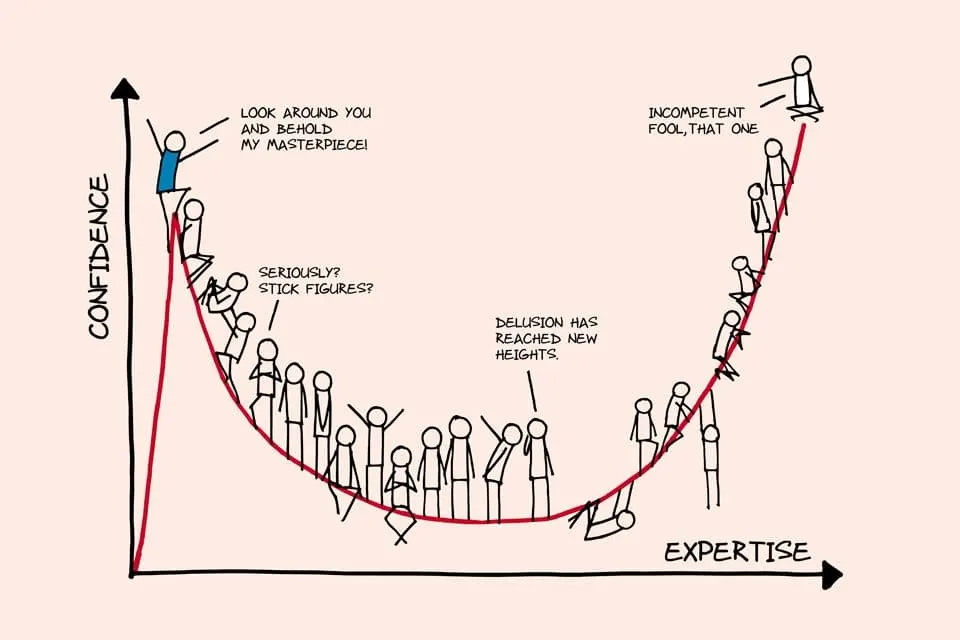
You start overconfident: I built a website in a weekend, how hard can this be? Then you hit real problems — asynchronous code behaving in ways you can't predict, state management spiraling, deployment pipelines breaking silently — and confidence craters. You enter the valley, where you finally know enough to see how much you don't know.
The valley is where most people quit. It's also where the real learning happens, because you're finally facing problems complex enough to force deep understanding. The inflection point arrives when debugging stops feeling like magic and starts feeling like detective work — when you read an error message and already know which file to open.
Master 1 core ecosystem for 6+ months before chasing shiny new frameworks.
30 minutes of daily practice compounds far faster than sporadic weekend marathons.
Use AI to speed up boilerplate and get unstuck, never to outsource comprehension.
Tracing bugs at 11 PM isn't a distraction from learning—that frustration IS the learning.
If you're in the valley right now, that's the only real difference between you and the people who made it through: they kept going. They built systems that kept them writing code on the days they didn't want to. The inflection point is coming. You won't recognize it when it arrives — only months later, when the problems that used to paralyze you start feeling routine.
Published on July 27, 2026